
Kids Kare
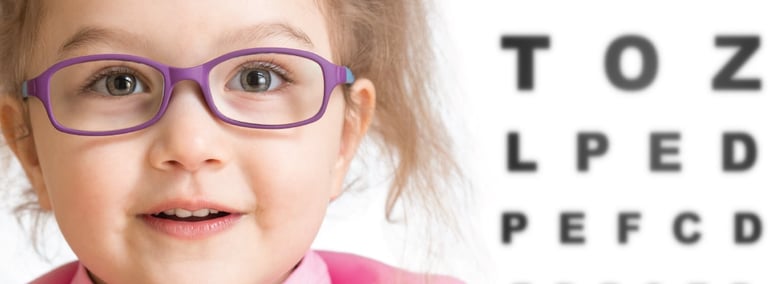
Your Childs First Eye Exam
should be by their......
1st
Birthday
AMBLYOPIA
It will "PAY OFF"!
AKA: Lazy Eye
More common Childhood Eye Issues
Childhood Amblyopia, commonly known as lazy eye, is a neurodevelopmental condition where the brain and one eye fail to work together properly. Even though the eye itself usually looks structurally normal, the brain suppresses or "ignores" the visual signals coming from it, favouring the stronger eye instead.
Because the visual system develops rapidly between Birth and age 7, untreated amblyopia during this critical window
can lead to permanent changes in the brain's visual pathways.
Early detection can greatly improve your child's future with their confidence, education and social development, including their perspective on their own life and their world around them.
What to look for
The symptoms of Amblyopia can be constant, or they may drift into view intermittently when the child is fatigued or unwell.
Most parents would have difficulty identifying or detecting their child's eyes with a slight misalignment.
Eye Drift: One eye visibly misaligns from the object of focus.
Light Reflection: The light reflection does not sit in the exact center of both pupils simultaneously.
Head Tilting: The child tilts or turns their head to try to mechanically line up their visual field.
Squinting or Closing One Eye: This is frequently noticed in bright sunlight to block out double vision.
Poor Depth Perception: The child bumps into objects, struggles on stairs, or shows general physical clumsiness.
Causes
Amblyopia develops early in life, typically between birth and age 7, due to an abnormal visual experience.
Eyewear: A significant difference in prescription (nearsightedness, farsightedness, or astigmatism) between the eyes causes one eye to send a much blurrier image to the brain than the other.
Strabismus: An imbalance in the eye muscles causes the eyes to cross or turn out. To avoid double vision, the brain suppresses the image from the misaligned eye.
Deprivation: Physical blockages like a congenital cataract, corneal clouding, or a severely droopy eyelid (ptosis) prevent light from entering the child's eye, disrupting normal vision growth
Treatments
Treatment goals are designed to restore clear vision, straighten the eyes, and establish balanced 3D perception.
Specialists often combine several approaches, this can greatly help with reducing the long term effects of STRABISMUS
Prescription Eyeglasses: Correcting underlying farsightedness or nearsightedness can fully straighten the eyes without further intervention.
Patching Therapy : Placing an adhesive patch over the dominant "strong" eye forces the brain to process signals from the misaligned eye, strengthening its neurological pathways.
Atropine Eye Drops: Temporarily blurring vision in the strong eye acts as a chemical alternative to a physical patch.
Vision Therapy: A regimen of targeted, specialized eye exercises strengthens eye-brain coordination and spatial focus.
Strabismus Surgery: If glasses or patching fail to align the eyes, a pediatric ophthalmologist can surgically loosen or tighten the eye muscles to mechanically balance them.
Long-Term Issues (If Untreated)
If left uncorrected during the critical stages of early childhood development, strabismus can cause structural, permanent issues
Strabismus: To prevent confusing double vision, the child's brain permanently shuts off or ignores the visual input from the turned eye. This causes the physical pathways from that eye to the brain to atrophy, leading to permanent vision loss that cannot be corrected by glasses in adulthood.
Loss of 3D Vision: The child permanently loses binocular depth perception, meaning they will view the world in 2D and struggle with spatial orientation.
Psychosocial and Social: Visible eye misalignment in school-aged children frequently triggers Low Self-Esteem, Social Withdrawal, and an increased risk of Schoolyard Bullying.
Are you observing intermittent eye drifting in a young infant, or has an optometrist suggested a specific diagnosis?
Address
Deja Vu Optics 157 Water St, Campbellton, NB, E3N 3L4
Contacts
Text or Call: 506-753-6000
Fax: 506-753-6040
Email: dvooffice@dejavuoptics.com

1 Hr Service
In Office Lab
Large Stock of Single Vision Lenses for Distance and Reading