
Kids Kare
First Eye Exam should be by their......
Digital lifestyles are creating new challenges for children’s eyes. Learn more about myopia, strabismus, and amblyopia — and how early intervention protects long‑term vision.
1st
Birthday
Amblyopia
The largest growing issue facing Parents & Children in todays DIGITAL Lifestyle is "Myopia"
Screen Time being the dominating factor.
Lets Explore Growing and Common Issues with Early Vision Development
A visual condition where the eyes do not align properly with each other. While one eye focuses straight ahead, the other eye turns out, in, up or downward, Children do not outgrow true strabismus, meaning early intervention is essential to prevent permanent brain-to-eye vision loss
Commonly known as lazy eye, is a neurodevelopmental condition where the brain and one eye fail to work together properly. Even though the eye itself usually looks structurally normal, the brain suppresses or "ignores" the visual signals coming from it, favouring the stronger eye instead.
Click on the title to learn more.
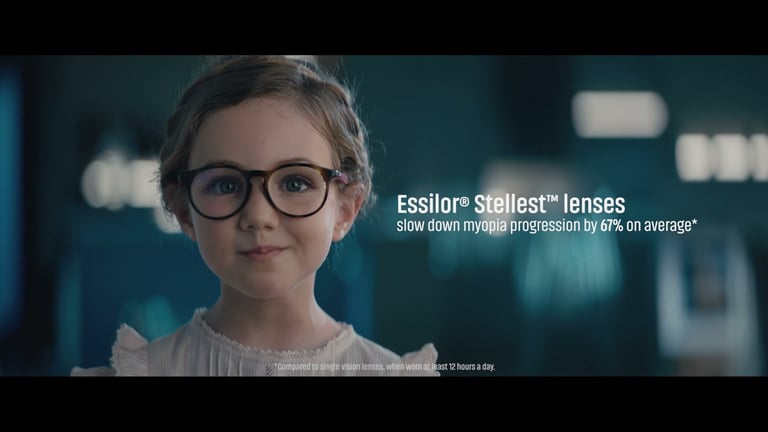
Is the largest growing issue facing Parents & Children in todays DIGITAL Lifestyle
Myopia in children primary causes falls into two categories
1. Genetics (Heredity)
Myopia heavily runs in families.
- One parent myopic: Your child has roughly double the risk of developing it.
- Both parents myopic: The risk jumps to nearly five times higher.
2. Environmental Factors
DIGITAL habits strongly influence the onset and progression of myopia in children.
- Excessive Close-Up Work: Prolonged, uninterrupted time spent focusing on objects up close (reading, drawing, or using smart devices/tablets) forces the eyes to accommodate. Over time, this strain can trigger the eyeball to elongate
- Lack of Outdoor Time: Spending too much time indoors deprives the eyes of natural sunlight. Research indicates that exposure to bright, natural light stimulates the release of dopamine in the retina, which helps prevent the eyeball from growing too long.
Manage or reduce risk
Eye care professionals generally recommend the following measures to slow or prevent childhood myopia
Limit screen time: Reduce recreational screen time and enforce frequent breaks during homework or reading.
Increase outdoor play: Encourage 1 to 2 hours of outdoor time daily.
Regular eye exams: Schedule comprehensive eye exams for your child to monitor vision and catch early signs of nearsightedness
Why Myopia Eyewear Matters
Unlike traditional prescription glasses, myopia control lenses are specifically designed for proactive management.
Slowing Progression: Clinical trials show that advanced lenses like Essilor Stellest can slow the progression of myopia by roughly 50% to 71%, depending on the technology.
Preventing High Myopia: Slowing the growth of the eyeball helps protect your child from developing high myopia, which can lead to vision-threatening conditions like retinal detachment or glaucoma in adulthood.
Ease of Use: For children who are uncomfortable with contact lenses or overnight Ortho-K, myopia control glasses are a highly effective, non-invasive first step.
Myopia affects a child far beyond simply making distant objects look blurry; it actively shapes their academic success, physical development, and long-term ocular health.
Because children often do not realize their vision is abnormal, they rarely complain, meaning the physical and behavioral side effects usually show up first.
Classroom Learning and School Performance
A child with uncorrected myopia struggles to see the whiteboard, projector screens, or visual presentations clearly.
Attention Issues: Teachers frequently mistake a myopic child’s lack of focus, daydreaming, or fidgeting for a behavioural problem or ADHD, when the child has simply lost interest because they cannot see the lesson.
Academic Decline: Studies show uncorrected nearsightedness directly correlates with a drop in core academic performance, particularly in reading comprehension and mathematics, where tracking distant visual data is essential.
Fatigue: The constant muscular strain to focus triggers digital eye strain, chronic headaches, and heavy physical exhaustion by midday, shortening their overall attention span.
Physical Coordination and Sports
When playing sports or running outdoors, clear distance vision is required to calculate spatial depth, track fast-moving objects, and recognize targets.
Loss of Interest: Children with undiagnosed myopia often struggle to catch balls, navigate playground equipment safely, or keep up with peers in fast paced games.
Social Withdrawal: Repeated coordination mishaps due to poor distance awareness can lead to a drop in self-esteem, causing them to withdraw from team sports and group activities.
Long-Term Medical Risks to the Eyeball
The most significant threat of childhood myopia is its progressive nature. Because a child’s eye grows continuously until early adulthood, early-onset myopia causes the eyeball to stretch excessively. According to clinical updates hosted by platforms like the National Institutes of Health (PMC), severe axial elongation structurally thins the internal tissue layers, exponentially increasing the lifetime risk of permanent adult eye diseases:
Eye Condition How Myopia Causes Lifetime Risk Increase (High Myopia)
Retinal Detachment: The retina stretches too thin, tearing away from its supporting tissue. (12x higher)
Glaucoma: Optic nerve damage occurs from structural deformation and internal pressure sensitivity. (3x higher)
Early Cataracts: Pathological changes degrade and cloud the lens about 10 years earlier than normal. (4.5x higher)
Myopic Macular Degeneration: Severe structural stretching causes cell death in the central vision zone. (Up to 845x higher)
Early Warning Signs to Watch For
If your child is experiencing any of the following, schedule a Eye Exam immediately:
Squinting, frowning, or tilting the head when looking at distant objects.
Sitting unusually close to the television or holding digital screens directly up to the face.
Rubbing their eyes frequently or complaining of itchy, burning, or tired eyes after a school day.
Short attention span
Frequently Frustrated
Frequent Headaches
If you are noticing any of these behaviors or signs an eye exam and eyewear could greatly reduce these issues
MYOPIA
Common Childhood Eye Issues
Childhood Strabismus, is a visual condition where the eyes do not align properly with each other. While one eye focuses straight ahead, the other eye turns out, in, up or downward, Children do not outgrow true strabismus, meaning early intervention is essential to prevent permanent brain-to-eye vision loss.
Early detection can greatly improve your child's future with their confidence, education and social development, including their perspective on their own life and their world around them.
What to look for
The symptoms of strabismus can be constant, or they may drift into view intermittently when the child is fatigued or unwell.
Most parents would have difficulty identifying or detecting their child's eyes with a slight misalignment.
Eye Drift: One eye visibly misaligns from the object of focus.
Asymmetric Reflections: The light reflection does not sit in the exact center of both pupils simultaneously.
Head Tilting: The child tilts or turns their head to try to mechanically line up their visual field.
Squinting or Closing One Eye: This is frequently noticed in bright sunlight to block out double vision.
Poor Depth Perception: The child bumps into objects, struggles on stairs, or shows general physical clumsiness.
Causes
Strabismus is caused by a failure of the eye muscles to coordinate effectively with the brain's visual control center.
Eyewear: Severe uncorrected farsightedness (hyperopia) forces a child to strain heavily to focus, pulling the eyes inward. T
Genetics: A family history of misaligned eyes significantly increases a child's risk.
Neurological Conditions: Since the brain controls the six extraocular muscles, conditions like cerebral palsy, Down syndrome, hydrocephalus, or brain trauma can disrupt muscle pathways.
Premature Birth: Babies born prematurely or with a low birth weight have higher rates of neuromuscular eye issues
Treatments
Treatment goals are designed to restore clear vision, straighten the eyes, and establish balanced 3D perception.
Specialists often combine several approaches, this can greatly help with reducing the long term effects of STRABISMUS
Prescription Eyeglasses: Correcting underlying farsightedness or nearsightedness can fully straighten the eyes without further intervention.
Patching Therapy : Placing an adhesive patch over the dominant "strong" eye forces the brain to process signals from the misaligned eye, strengthening its neurological pathways.
Atropine Eye Drops: Temporarily blurring vision in the strong eye acts as a chemical alternative to a physical patch.
Vision Therapy: A regimen of targeted, specialized eye exercises strengthens eye-brain coordination and spatial focus.
Strabismus Surgery: If glasses or patching fail to align the eyes, a pediatric ophthalmologist can surgically loosen or tighten the eye muscles to mechanically balance them.
Long-Term Issues (If Untreated)
If left uncorrected during the critical stages of early childhood development, strabismus can cause structural, permanent issues
Strabismus: To prevent confusing double vision, the child's brain permanently shuts off or ignores the visual input from the turned eye. This causes the physical pathways from that eye to the brain to atrophy, leading to permanent vision loss that cannot be corrected by glasses in adulthood.
Loss of 3D Vision: The child permanently loses binocular depth perception, meaning they will view the world in 2D and struggle with spatial orientation.
Psychosocial and Social: Visible eye misalignment in school-aged children frequently triggers Low Self-Esteem, Social Withdrawal, and an increased risk of Schoolyard Bullying.
Are you observing intermittent eye drifting in a young infant, or has an optometrist suggested a specific diagnosis?
STRABISMUS
Childhood Amblyopia, commonly known as lazy eye, is a neurodevelopmental condition where the brain and one eye fail to work together properly. Even though the eye itself usually looks structurally normal, the brain suppresses or "ignores" the visual signals coming from it, favouring the stronger eye instead.
Because the visual system develops rapidly between Birth and age 7, untreated amblyopia during this critical window
can lead to permanent changes in the brain's visual pathways.
Early detection can greatly improve your child's future with their confidence, education and social development, including their perspective on their own life and their world around them.
What to look for
The symptoms of Amblyopia can be constant, or they may drift into view intermittently when the child is fatigued or unwell.
Most parents would have difficulty identifying or detecting their child's eyes with a slight misalignment.
Eye Drift: One eye visibly misaligns from the object of focus.
Light Reflection: The light reflection does not sit in the exact center of both pupils simultaneously.
Head Tilting: The child tilts or turns their head to try to mechanically line up their visual field.
Squinting or Closing One Eye: This is frequently noticed in bright sunlight to block out double vision.
Poor Depth Perception: The child bumps into objects, struggles on stairs, or shows general physical clumsiness.
Causes
Amblyopia develops early in life, typically between birth and age 7, due to an abnormal visual experience.
Eyewear: A significant difference in prescription (nearsightedness, farsightedness, or astigmatism) between the eyes causes one eye to send a much blurrier image to the brain than the other.
Amblyopia: An imbalance in the eye muscles causes the eyes to cross or turn out. To avoid double vision, the brain suppresses the image from the misaligned eye.
Deprivation: Physical blockages like a congenital cataract, corneal clouding, or a severely droopy eyelid (ptosis) prevent light from entering the child's eye, disrupting normal vision growth
Treatments
Treatment goals are designed to restore clear vision, straighten the eyes, and establish balanced 3D perception.
Specialists often combine several approaches, this can greatly help with reducing the long term effects of Amblyopia
Prescription Eyeglasses: Correcting underlying farsightedness or nearsightedness can fully straighten the eyes without further intervention.
Patching Therapy : Placing an adhesive patch over the dominant "strong" eye forces the brain to process signals from the misaligned eye, strengthening its neurological pathways.
Atropine Eye Drops: Temporarily blurring vision in the strong eye acts as a chemical alternative to a physical patch.
Vision Therapy: A regimen of targeted, specialized eye exercises strengthens eye-brain coordination and spatial focus.
Amblyopia Surgery: If glasses or patching fail to align the eyes, a pediatric ophthalmologist can surgically loosen or tighten the eye muscles to mechanically balance them.
Long-Term Issues (If Left Untreated)
If left uncorrected during the critical stages of early childhood development, strabismus can cause structural, permanent issues
Amblyopia : To prevent confusing double vision, the child's brain permanently shuts off or ignores the visual input from the turned eye. This causes the physical pathways from that eye to the brain to atrophy, leading to permanent vision loss that cannot be corrected by glasses in adulthood.
Loss of 3D Vision: The child permanently loses binocular depth perception, meaning they will view the world in 2D and struggle with spatial orientation.
Psychosocial and Social: Visible eye misalignment in school-aged children frequently triggers Low Self-Esteem, Social Withdrawal, and an increased risk of Schoolyard Bullying.
Are you observing intermittent eye drifting in a young infant, or has an optometrist suggested a specific diagnosis?
AMBLYOPIA
Address
Deja Vu Optics 157 Water St, Campbellton, NB, E3N 3L4
Contacts
Text or Call: 506-753-6000
Fax: 506-753-6040
Email: dvooffice@dejavuoptics.com




1 Hr Service
In Office Lab
Large Stock of Single Vision Lenses for Distance and Reading